All images in this page copyright Haider Ali (2006)
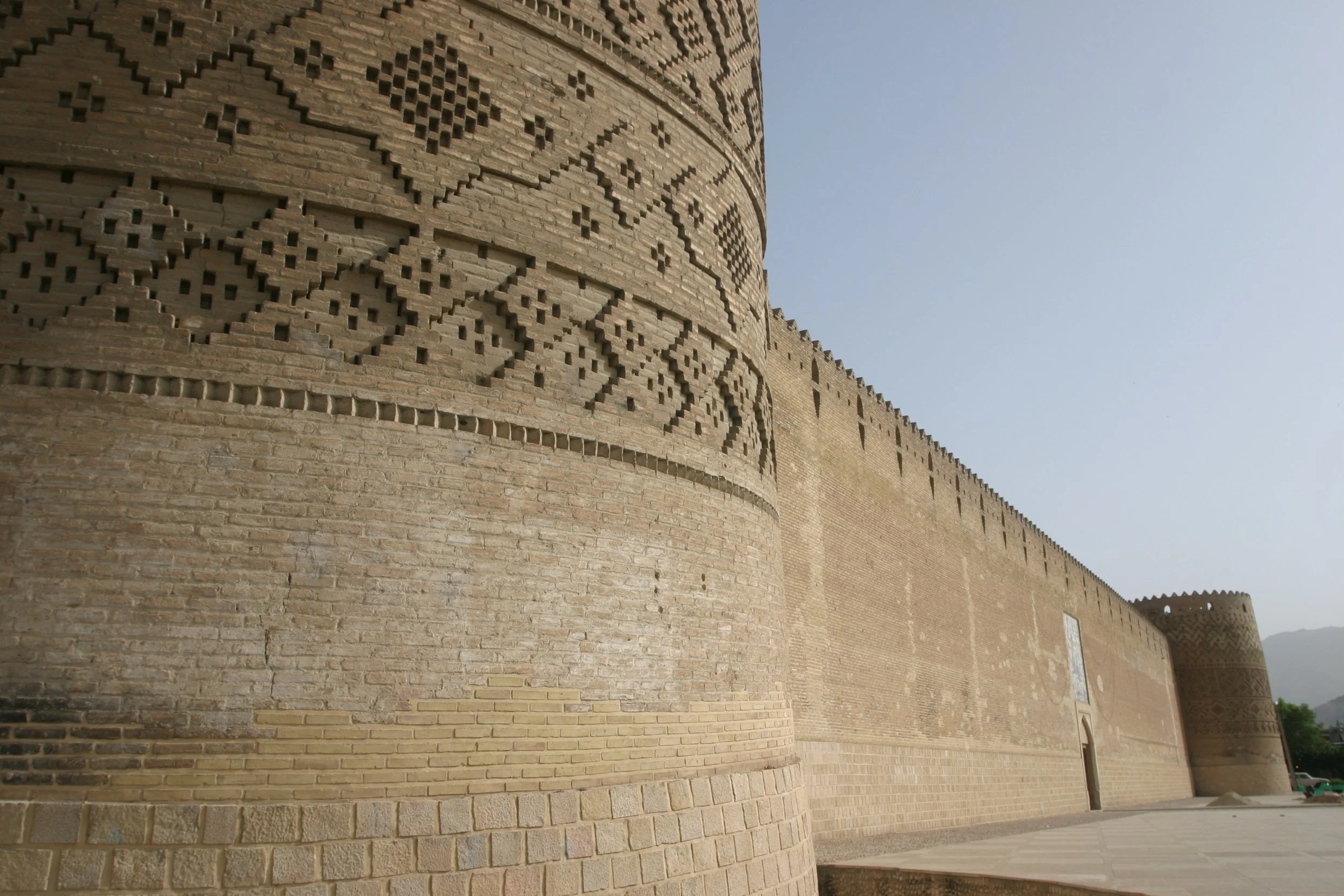
The imposing outer walls of the Arg of Karim Khan, Shiraz. The Zand-era citadel (c. 1766) displays the distinctive decorative brickwork — geometric chevrons and recessed square patterns — that characterise the military architecture of the period.
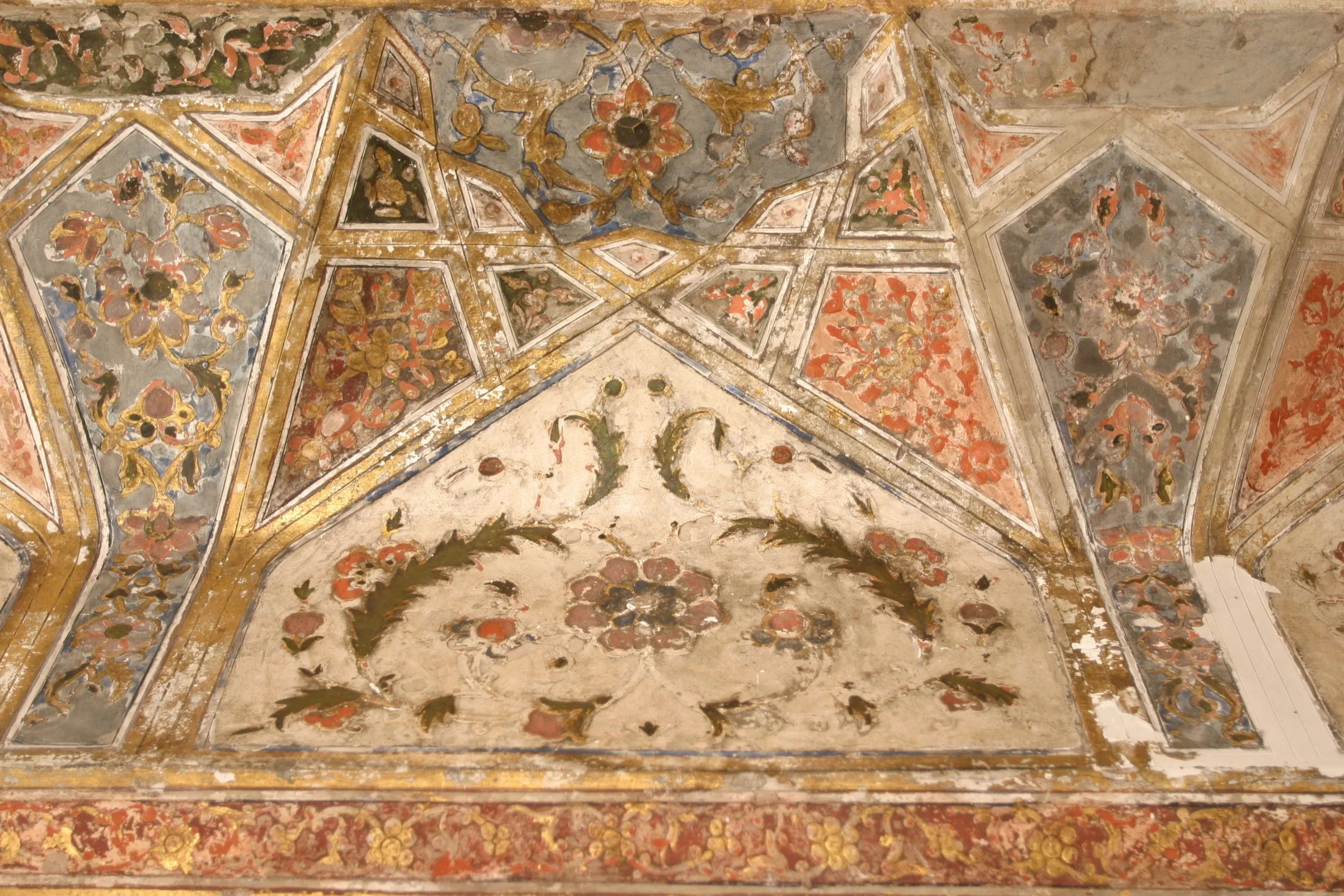
A painted ceiling panel inside the Arg of Karim Khan, revealing the residential opulence of the Zand court. Geometric star-and-triangle compartments frame delicate floral medallions rendered in terracotta, gold, slate blue and sage — a rare surviving example of Zand-period interior polychrome painting.
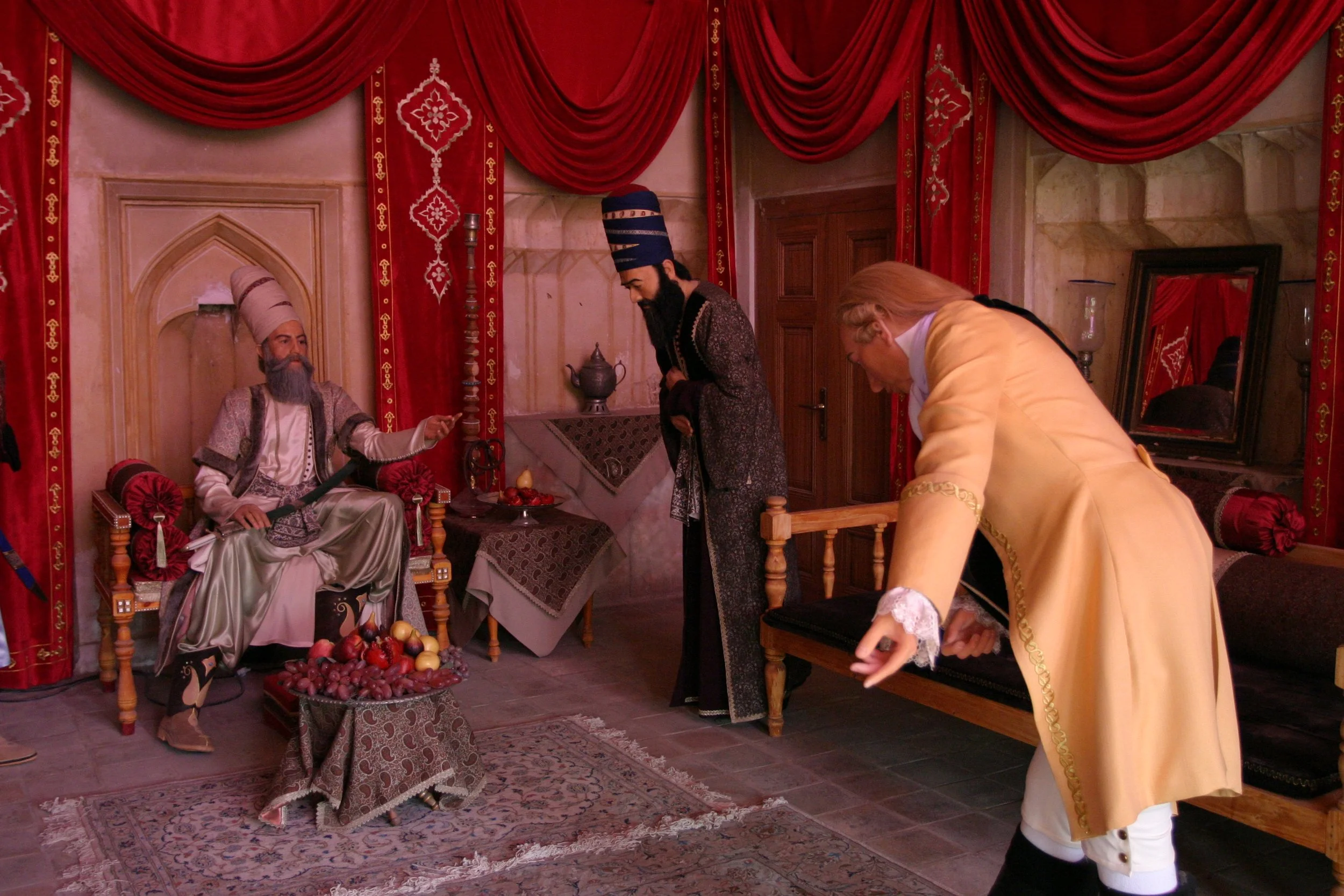
A museum diorama within the Arg of Karim Khan reconstructing a Zand court audience scene. A turbaned figure — likely representing Karim Khan Zand himself — receives a European envoy who bows in deference, with a courtier in attendance. The scene reflects Shiraz's role as a centre of diplomatic and commercial exchange in 18th-century Persia.
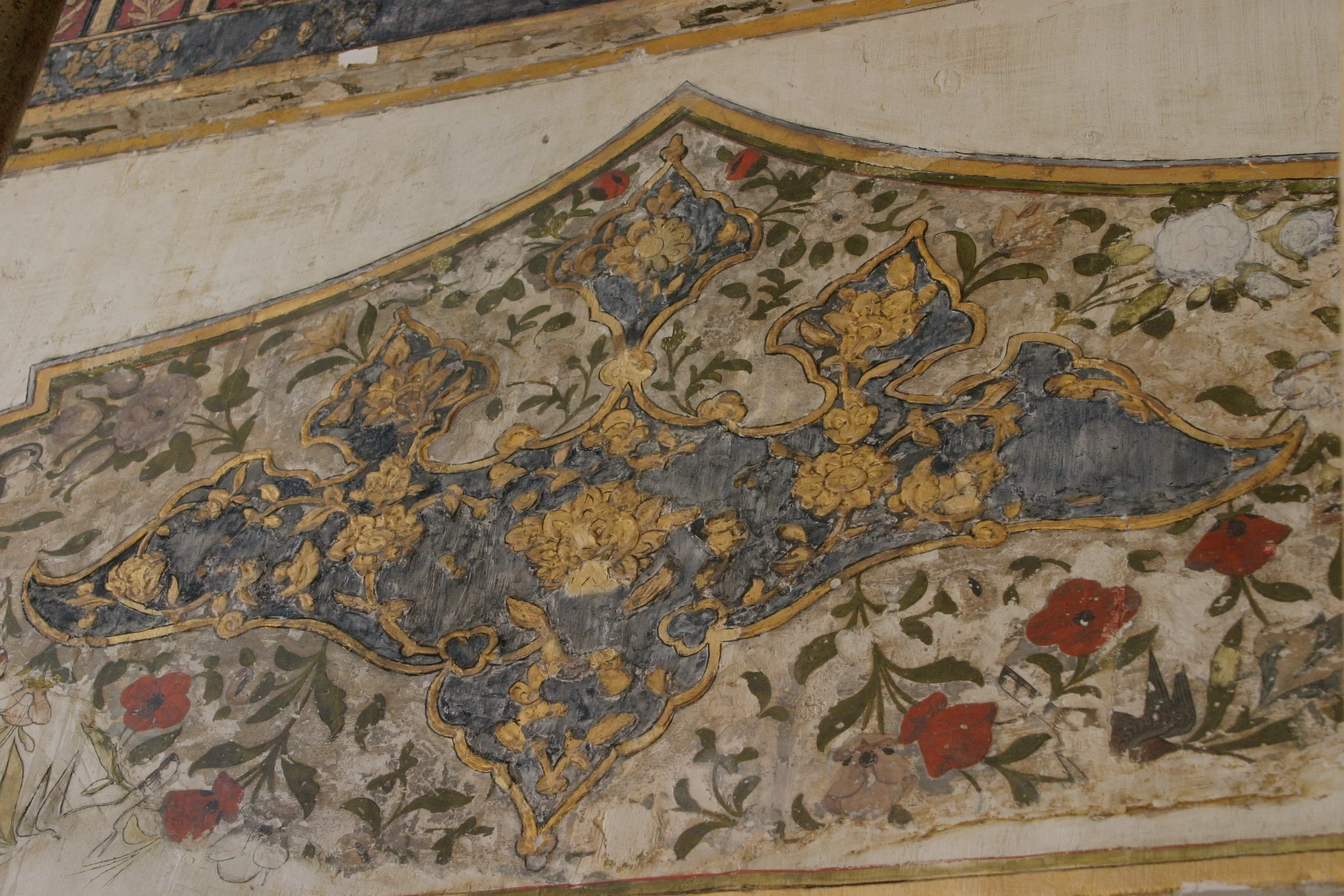
Detail of a wall painting from within the Arg complex: a central cartouche of gold arabesque florals on a deep slate-blue ground, set against a wider field of red poppies and trailing foliage. The composition echoes the aesthetic of Persian carpet design transposed onto architectural surfaces.
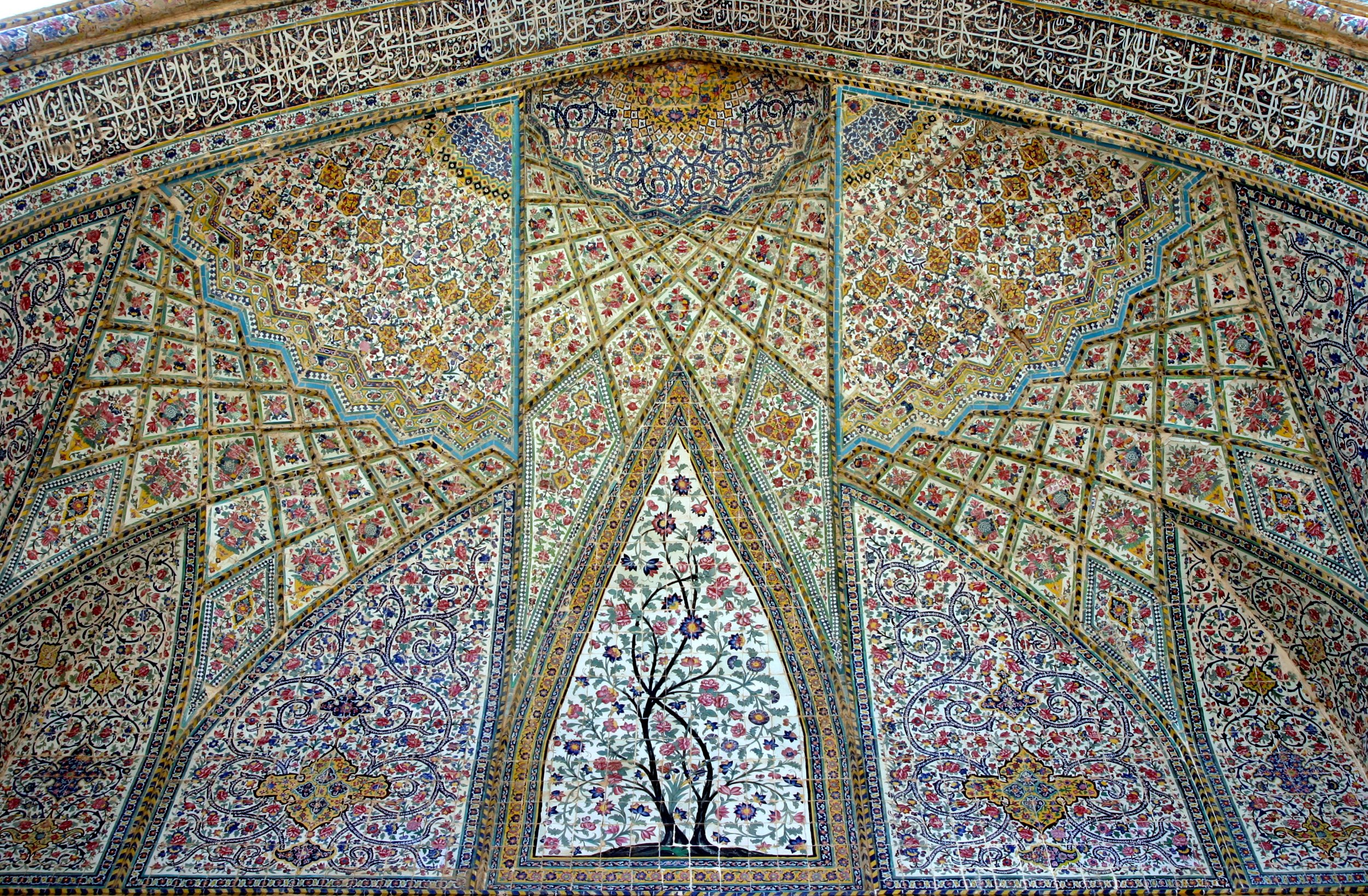
The tiled iwan of the Vakil Mosque, Shiraz. Every surface of this soaring pointed arch is encrusted with polychrome faience — thousands of hand-painted tiles forming an unbroken field of interlocking floral arabesques in rose, cobalt, gold and sage. At the centre, a solitary tree of life rises within a lancet niche, its bare branches contrasting with the exuberant botanical abundance surrounding it. A band of white calligraphy in Thuluth script runs along the upper border, anchoring the visual splendour in sacred text. Built under Karim Khan Zand in the 18th century, the mosque represents the apogee of Zand decorative art.
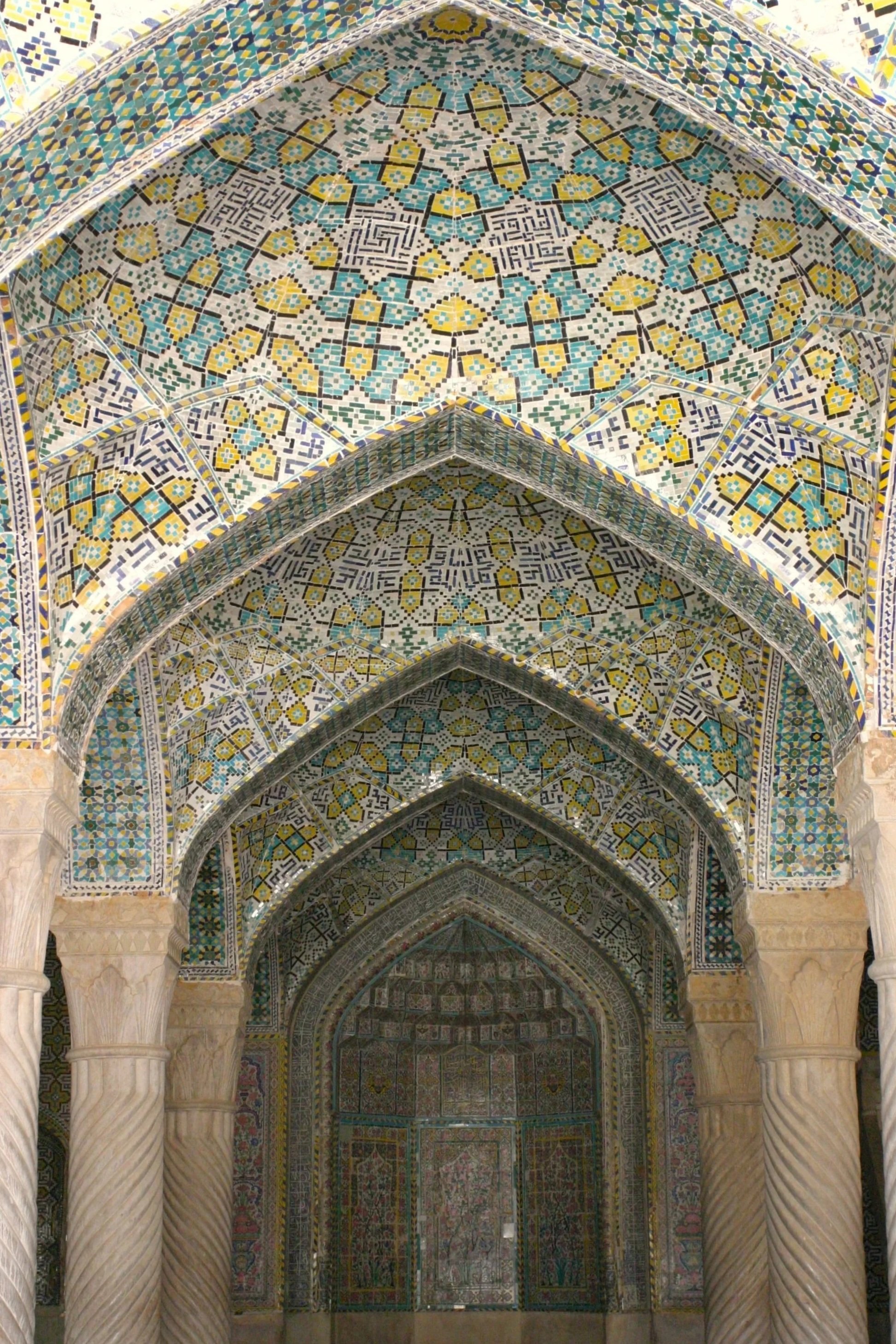
A receding sequence of pointed arches inside the Vakil Mosque, Shiraz, each vault smothered in fine mosaic tilework of turquoise, mustard yellow, white and black. The geometric patterns — interlocking stars, Kufic script fragments, and cross-and-lozenge lattices — shift subtly from tier to tier as the eye travels inward, creating a sense of depth that draws the worshipper towards the prayer hall beyond. Flanking the entrance, the Vakil's celebrated twisted stone columns — their helical fluting carved from a single piece of marble — frame the composition with quiet structural confidence. The interplay between the cool geometry of the tile surfaces and the organic spiral of the columns is one of the great understated contrasts in Zand architecture.
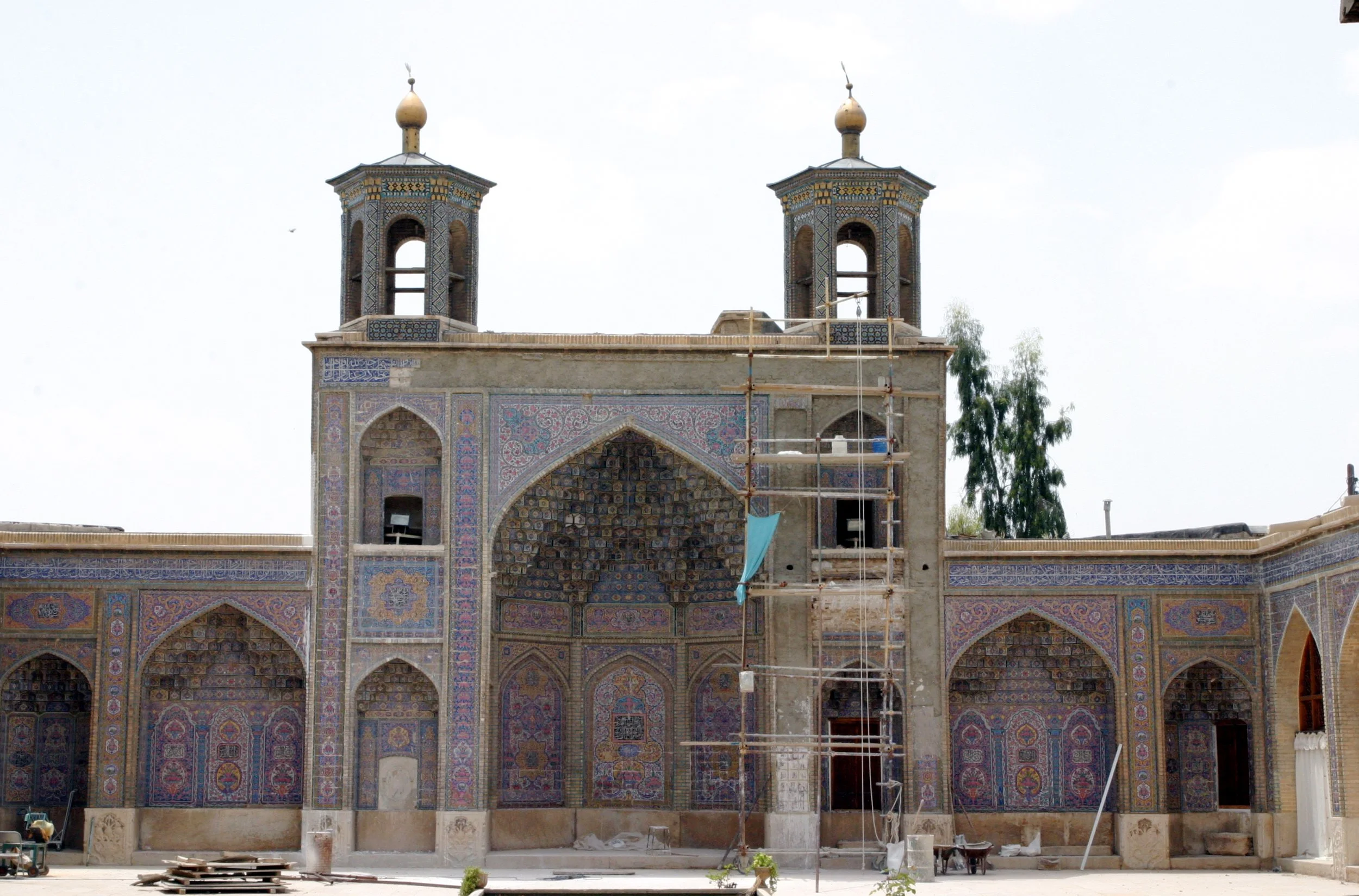
The courtyard facade of the Nasir al-Mulk Mosque, Shiraz, caught mid-restoration. Scaffolding climbs the central iwan, where tiles have been partially stripped back to bare brick — revealing the structural skeleton beneath the ornamental surface. The flanking arcade walls retain their dense polychrome tilework of pink, blue and gold arabesques, while the two distinctive square minarets with their golden finials rise symmetrically above. The juxtaposition is quietly arresting: a building of extraordinary surface beauty exposed in its plainness, the labour of heritage conservation made visible. A reminder that what we admire as timeless requires constant, unglamorous maintenance to remain so.
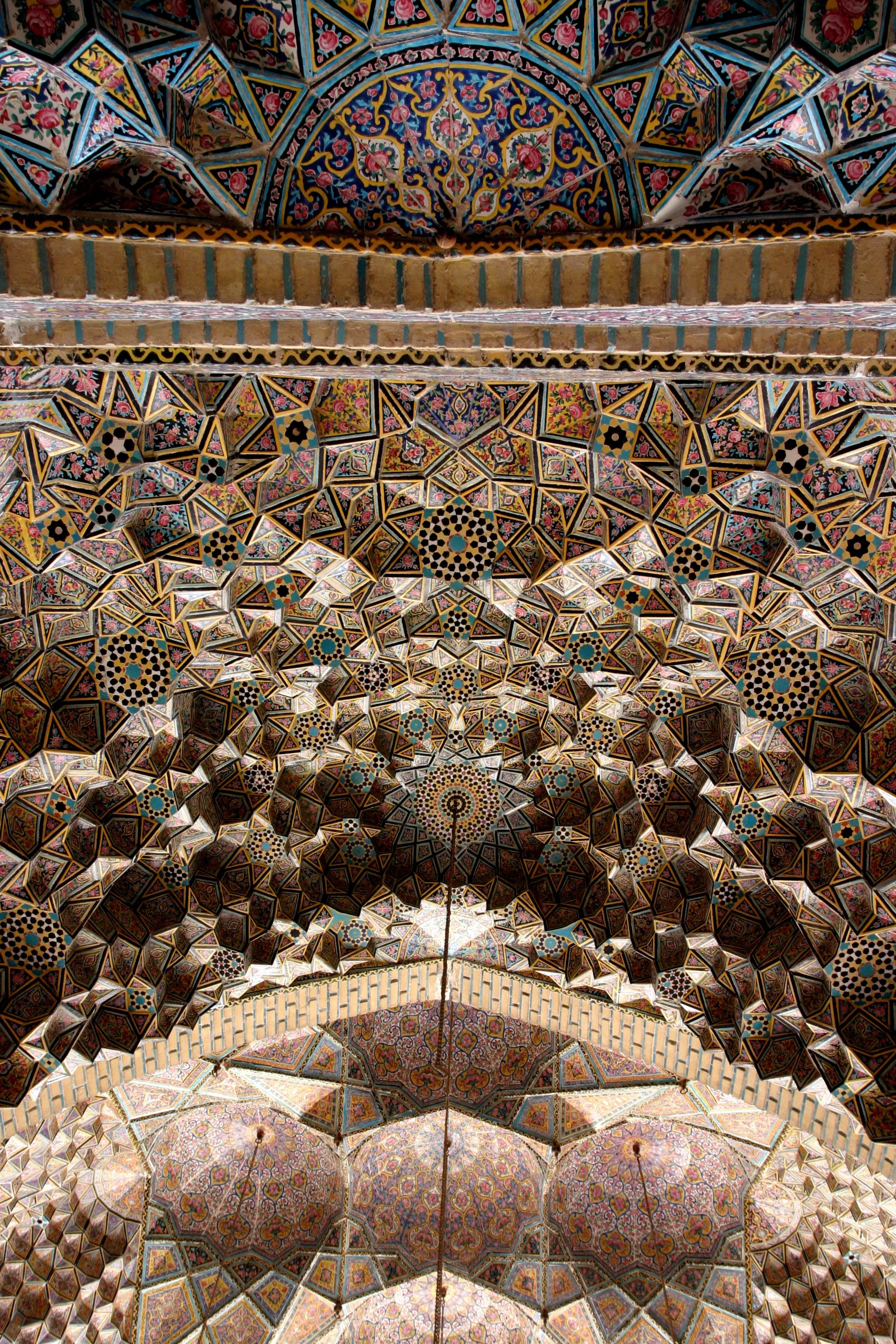
Looking straight up into the layered muqarnas vaulting of the Nasir al-Mulk Mosque (the "Pink Mosque"), Shiraz. Tier upon tier of geometric stalactite cells descend in fractal complexity, each facet painted with intricate floral rosettes in rose pink, cobalt, teal and gold. The effect is of a crystalline honeycomb in perpetual bloom — Islamic geometry and Persian botanical ornament fused into a single overwhelming surface. Built between 1876 and 1888 under the Qajar governor Mirza Hassan Ali Nasir al-Mulk, the mosque is famed for the way its stained-glass windows bathe interiors in pools of coloured light at dawn — but even without that spectacle, the ceiling alone is among the most technically intricate in all of Iranian architecture.
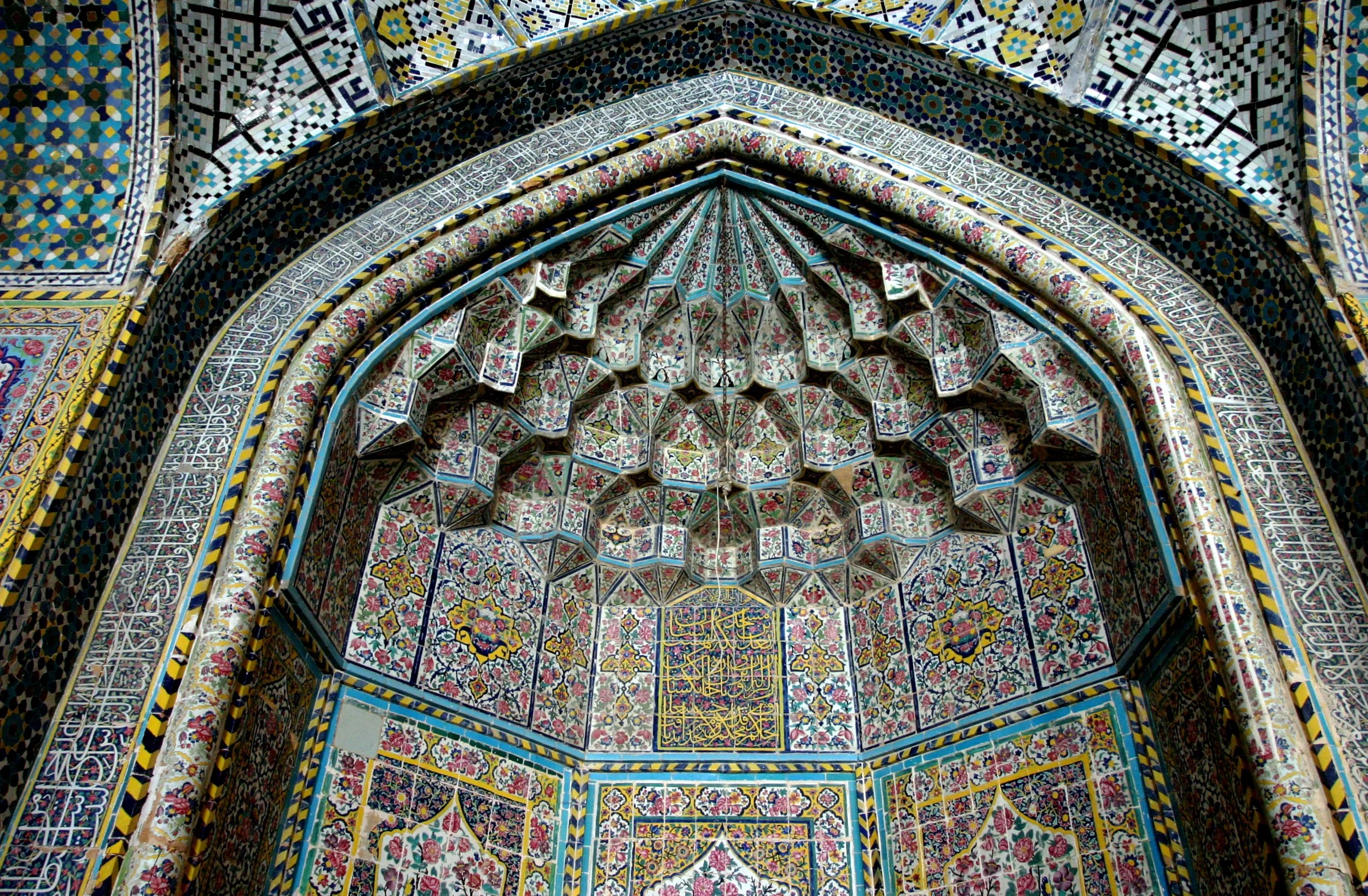
The prayer niche (mihrab) of the Nasir al-Mulk Mosque, Shiraz. A cascading muqarnas half-dome fans outward from a central point like a petrified waterfall of geometric cells, each facet tiled with pink roses and floral sprays. Below the stalactite vault, a rectangular cartouche carries a Qur'anic inscription in gold Thuluth script on a deep blue ground — the focal point towards which all this ornamental energy converges. The surrounding arch is banded in yellow and black chevrons, framed by dense white calligraphic borders on either side. The mihrab exemplifies the defining tension of Persian mosque architecture: the pull between infinite decorative elaboration and the singular stillness of the direction of prayer.
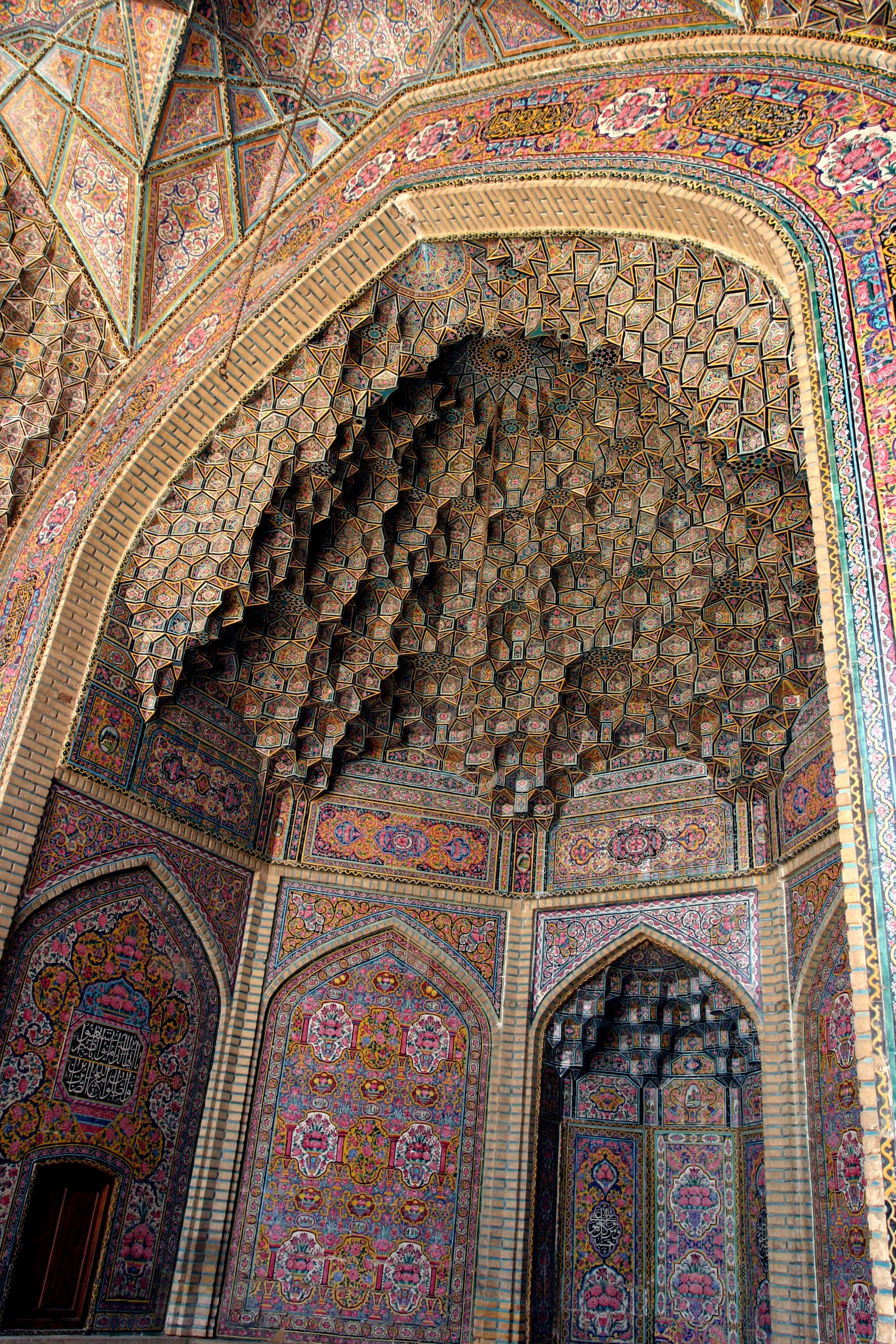
The great iwan of the Nasir al-Mulk Mosque, Shiraz, seen from the courtyard. A massive muqarnas half-dome fills the arch — hundreds of projecting geometric cells in terracotta and gold cascading downward like a frozen avalanche of honeycombs, their depth and shadow giving the vault an almost tactile, three-dimensional weight quite different from the flat tile surfaces surrounding it. Below, the spandrels and lower walls are sheathed in Qajar floral tilework of exceptional density — bouquets, medallions and cartouches in pink, teal, mustard and ivory, with calligraphic panels at the margins. The structural brick courses between the arches are left deliberately exposed, their restrained regularity throwing the extravagance of every decorated surface into sharp relief. This is Persian architecture at its most theatrical: every element competing for attention, yet held together by a deeply ingrained sense of compositional order.
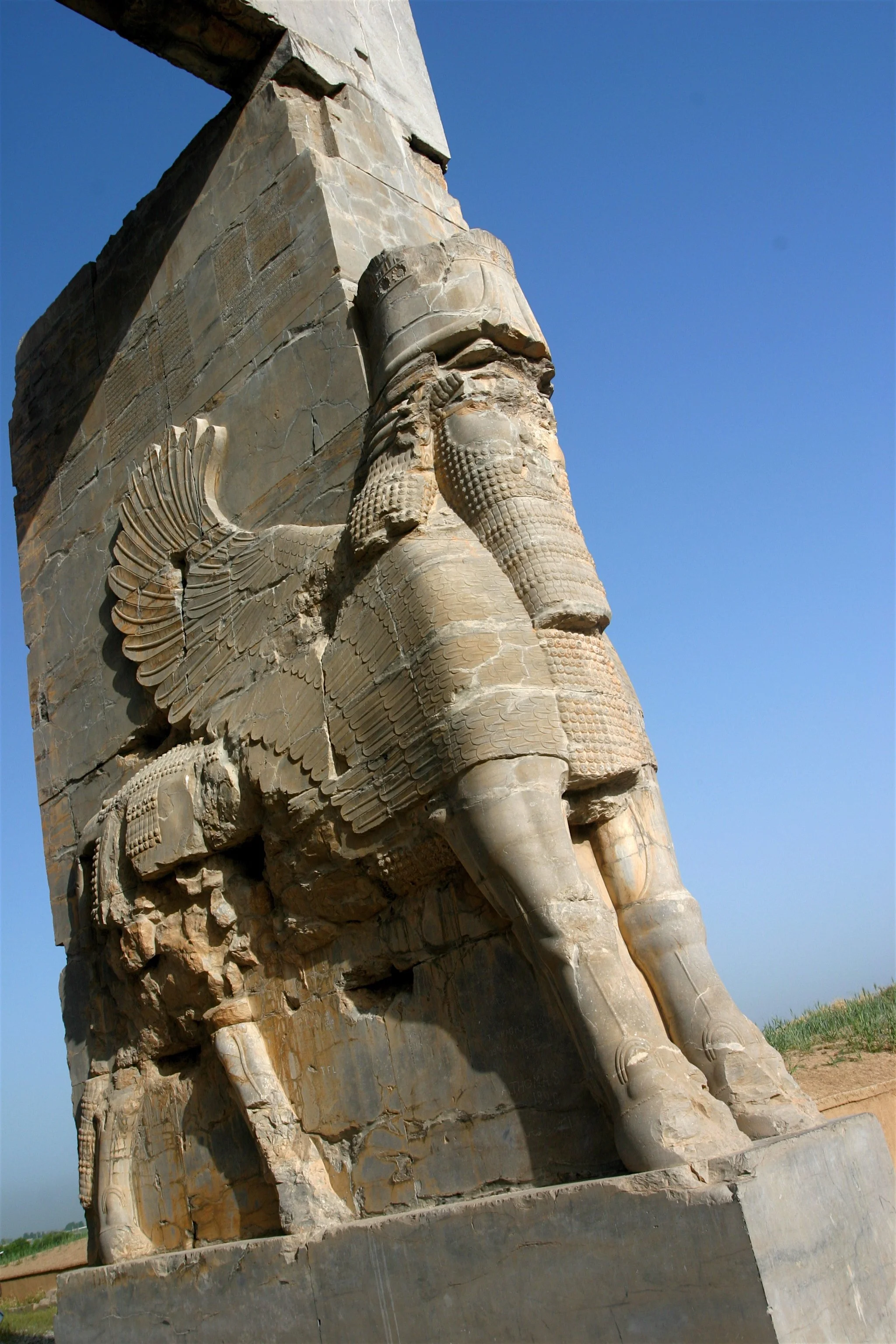
A lamassu — winged bull with a human head — guarding the Gate of All Nations at Persepolis, circa 486 BCE. Carved from a single massive block of grey limestone, this colossal apotropaic figure once flanked the ceremonial entrance through which delegations from across the Achaemenid Empire passed to present tribute to the Great King. The head, now damaged, would have worn the horned crown of divine authority; the body combines the strength of a bull, the flight of an eagle, and the intelligence of a man — a composite of sovereign power drawn from a broader Near Eastern tradition shared with Assyrian palace architecture. Photographed from below and at an oblique angle, the sheer physical scale becomes visceral: this is sculpture conceived not for aesthetic contemplation but as an instrument of awe.
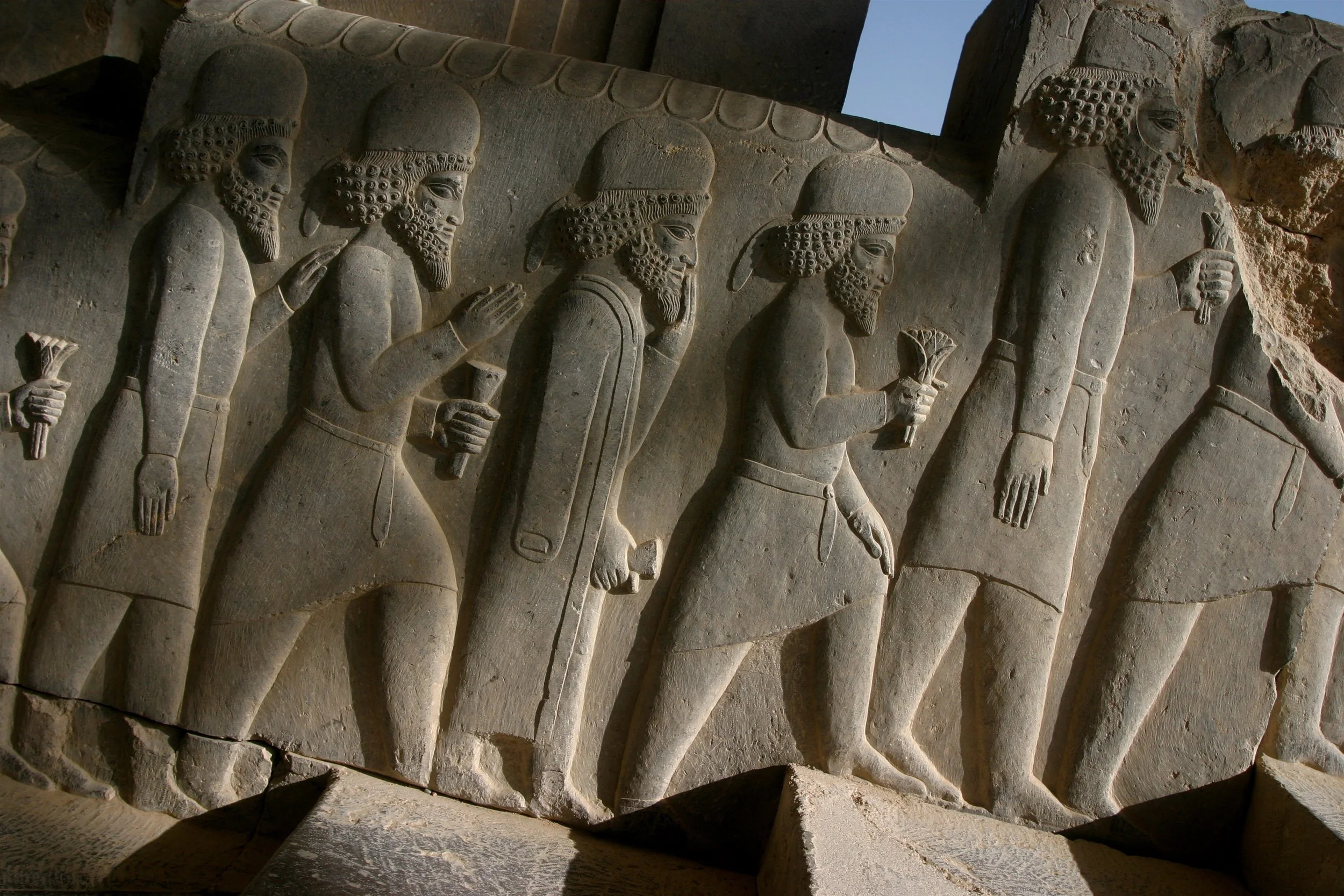
Tribute bearers in procession, Apadana staircase reliefs, Persepolis, c. 515–465 BCE. Carved in the characteristically shallow but precise Achaemenid style, these bearded figures advance in measured step, each carrying offerings — lotus flowers, a vessel, what appears to be a length of folded cloth. Their distinctive rounded caps and dress suggest they represent one of the many delegations depicted on the famous eastern and northern staircase friezes, where scholars have identified over two dozen subject nations of the empire bringing gifts to the New Year (Nowruz) ceremony. What is striking even in close-up is the restrained individuality of each face — the curl of a beard, a slight turn of the head — within a rigorously regularised compositional order. This tension between the collective and the particular is the defining quality of Persepolitan relief, and one of the reasons these carvings remain so compelling 2,500 years after the chisels were laid down.
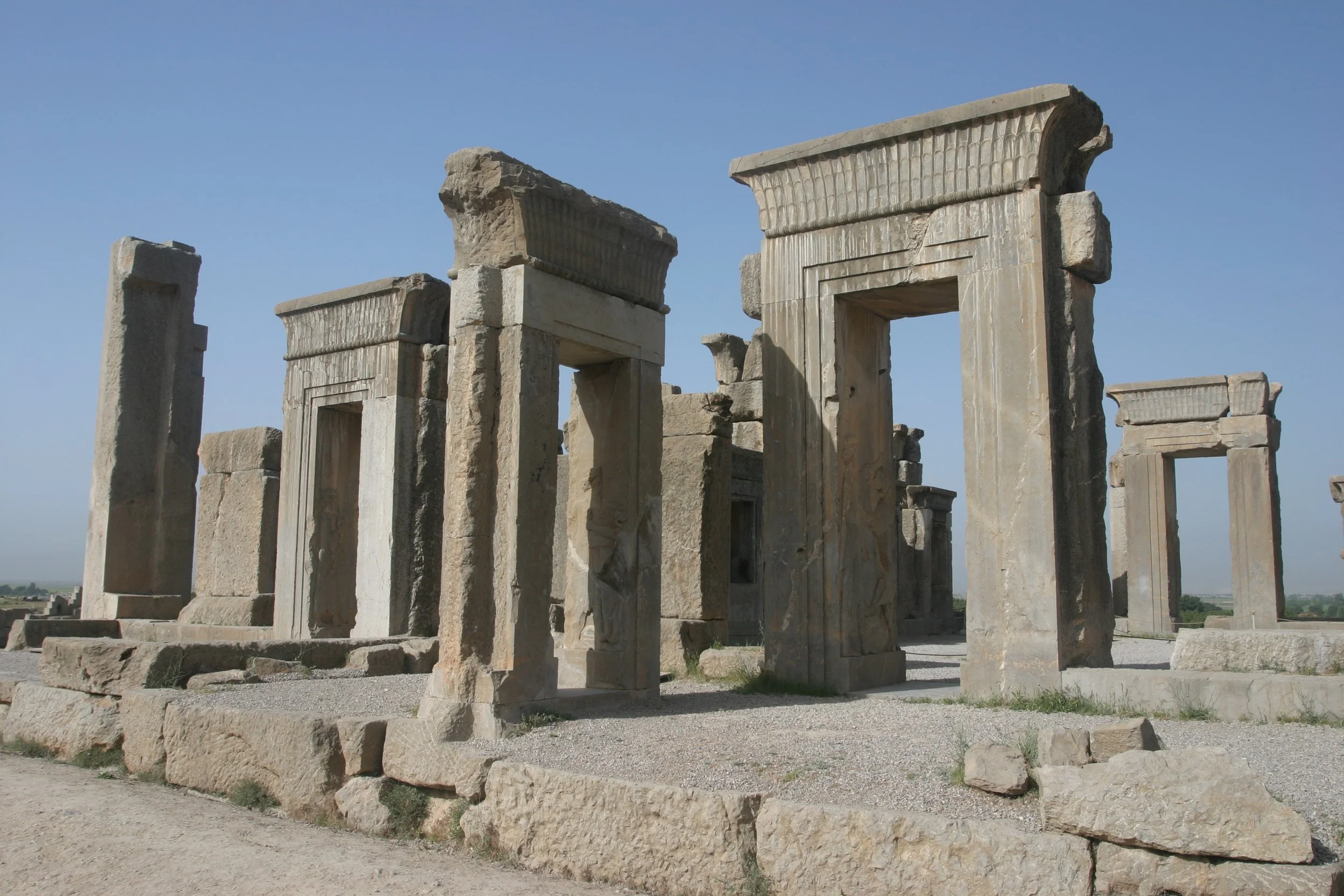
The standing doorframes of the Tachara — the private palace of Darius I — at Persepolis, looking across the terrace towards the Fars plain. What survives is essentially a grammar of thresholds: massive limestone jambs topped with the distinctive Egyptian-derived cavetto cornice, its fluted profile still crisp after two and a half millennia. The doors themselves are long gone, but the frames remain as a kind of architectural ghost — portals leading nowhere, yet still articulating the spatial hierarchy of a palace that once housed the ruler of the known world. The receding sequence of doorways, aligned on axis through successive rooms, gives a sense of the original processional logic of the building: entry was itself a ceremony, each threshold a measured increment of proximity to royal presence. Alexander's sack and burning of Persepolis in 330 BCE left these stones standing; what it consumed was everything that gave them meaning.
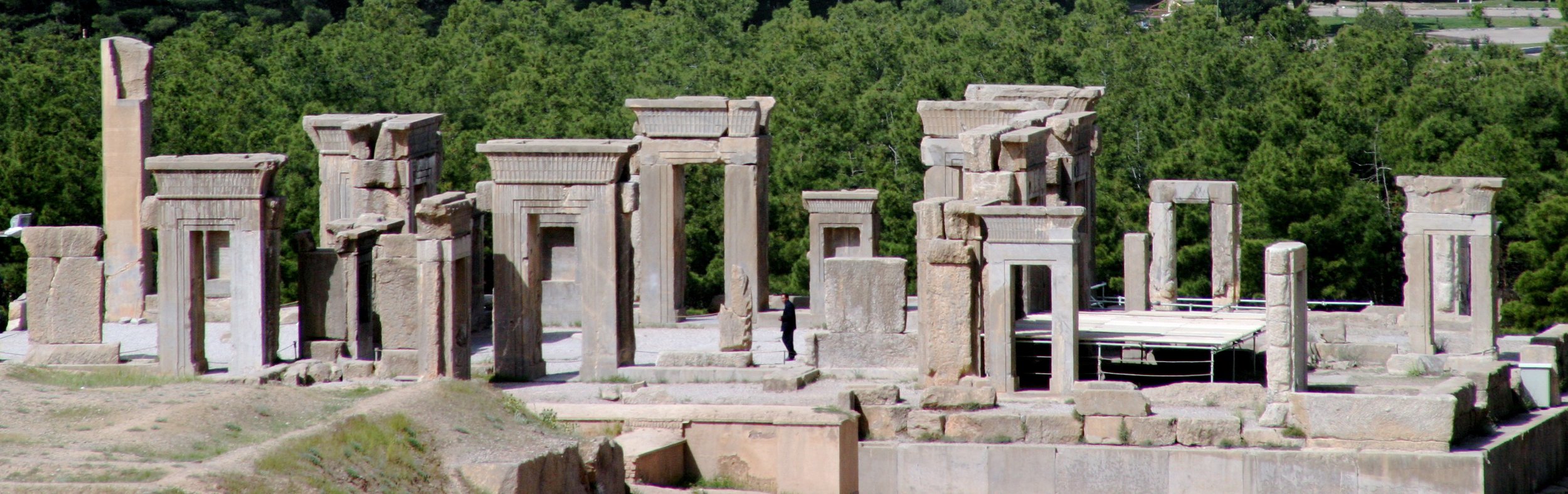
A panoramic view across the palace ruins of Persepolis, with the wooded slopes of Kuh-e Rahmat rising behind. A solitary figure in black — dwarfed by the surviving doorframes and jambs — provides the scale that no description can quite replace: these thresholds stand three to four times human height, and they are the remnants, not the grandeur. The wide shot reveals the full ruined landscape of the terrace — a scattered field of limestone blocks, half-standing walls and toppled column drums stretching across the plateau, the ghostly footprint of what was once the ceremonial heart of an empire stretching from the Aegean to the Indus. The contrast between the warm, ancient stone and the vivid green of the hillside gives the image an unexpected vitality — Persepolis not as dead ruin but as a living site, still embedded in a Fars landscape that continues to breathe around it.
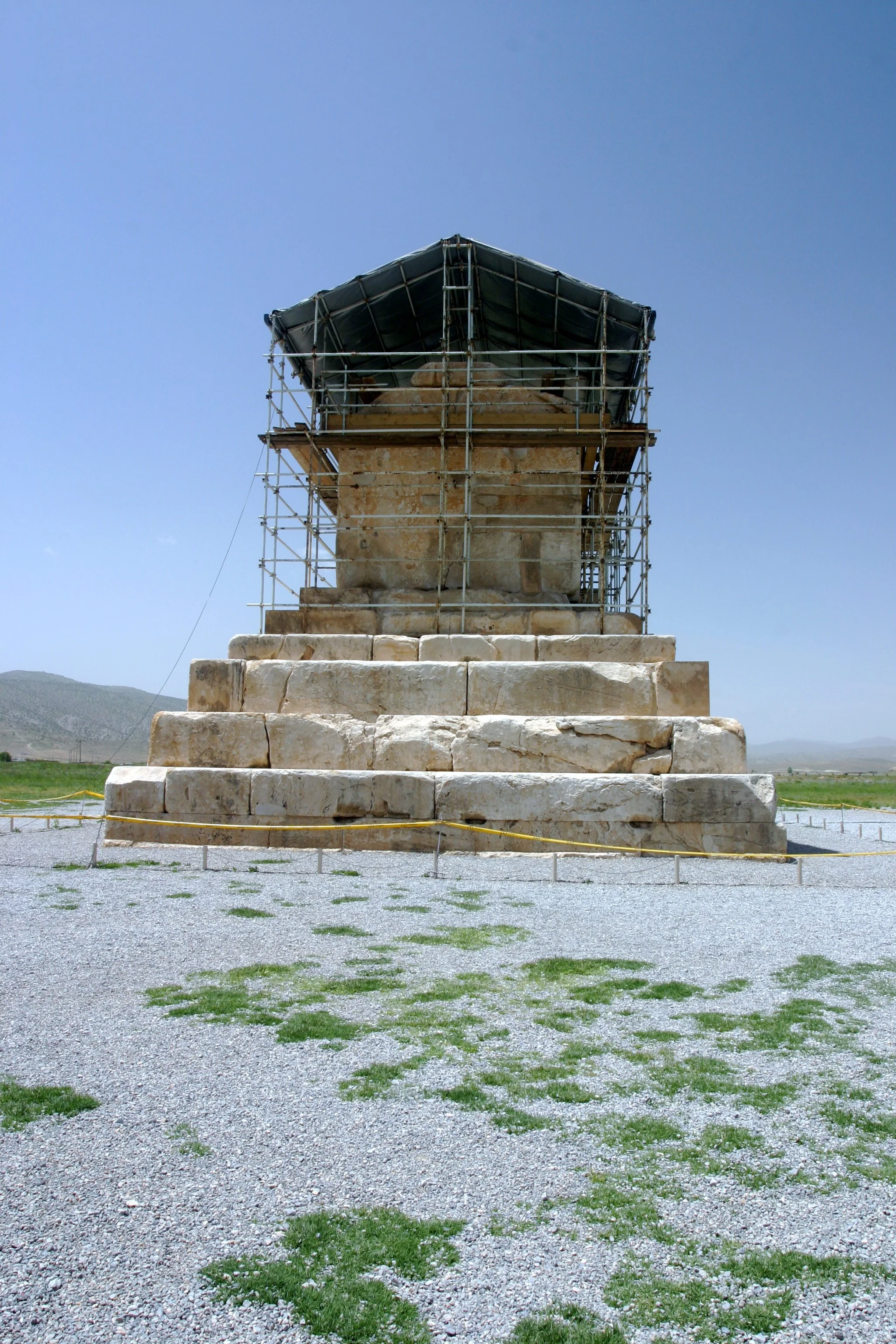
The Tomb of Cyrus the Great at Pasargadae, under conservation, Murghab plain, Fars Province. Six stepped limestone plinths — each course slightly smaller than the last — elevate a simple gabled burial chamber some eleven metres above the plain, the whole enclosed in scaffolding and a protective canopy at the time of this photograph. The design is austere to the point of severity: no relief carvings, no inscription survives in situ, no ornamental programme of any kind. It is architecture that communicates through mass, proportion, and solitude alone. Built around 530 BCE for the founder of the Achaemenid Empire — the king who issued the world's first known charter of human rights and permitted the Jewish return from Babylonian exile — the tomb stood for centuries as a site of veneration. Alexander the Great reportedly visited it twice, ordering its restoration after finding it plundered. It stands today in a near-empty plain, which is precisely the point: Cyrus chose isolation and elevation over spectacle, a restraint that still reads, across two and a half millennia, as confidence.
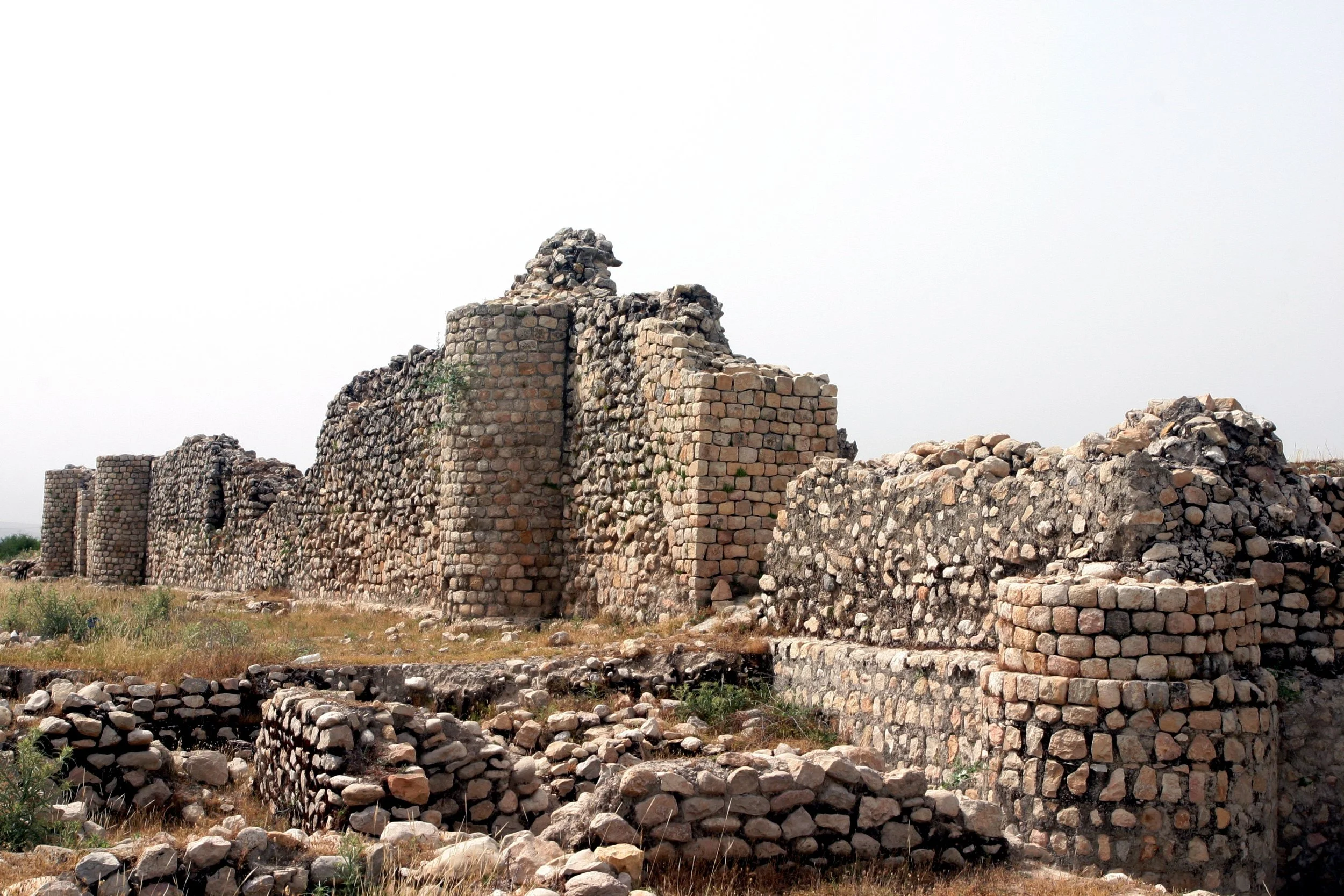
The ruined walls and towers of Bishapur, Fars Province, founded by the Sassanid king Shapur I around 266 CE following his celebrated victories over the Roman Emperor Valerian. One of the few ancient Iranian cities built on a formal grid plan — influenced, scholars suggest, by Roman prisoners of war pressed into its construction — Bishapur was a statement of imperial confidence at the moment the Sassanid dynasty was asserting itself as the successor to Achaemenid greatness. The rubble-core curtain walls and projecting rounded towers visible here are characteristic of Sassanid military architecture, built to command the fertile Shapur River valley on the road between Shiraz and the Persian Gulf. Nearby, Shapur's rock reliefs at Naqsh-e Rostam and Tang-e Chogan record the same Roman triumph in monumental carved imagery. The site remains largely unexcavated, its full extent still emerging from the Fars hillside — a Sassanid capital that once rivalled Ctesiphon, now quietly dissolving back into the landscape that produced it.